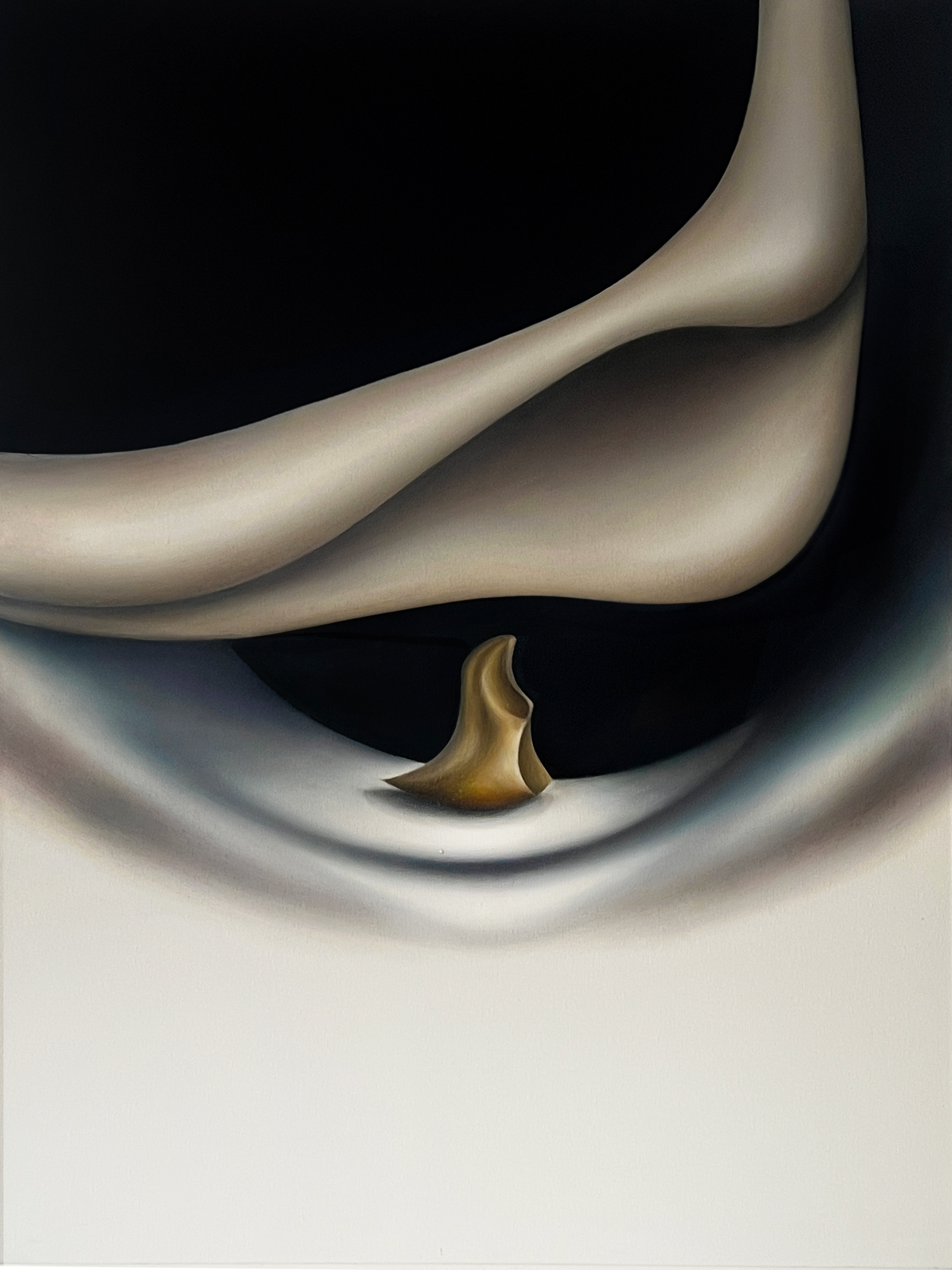
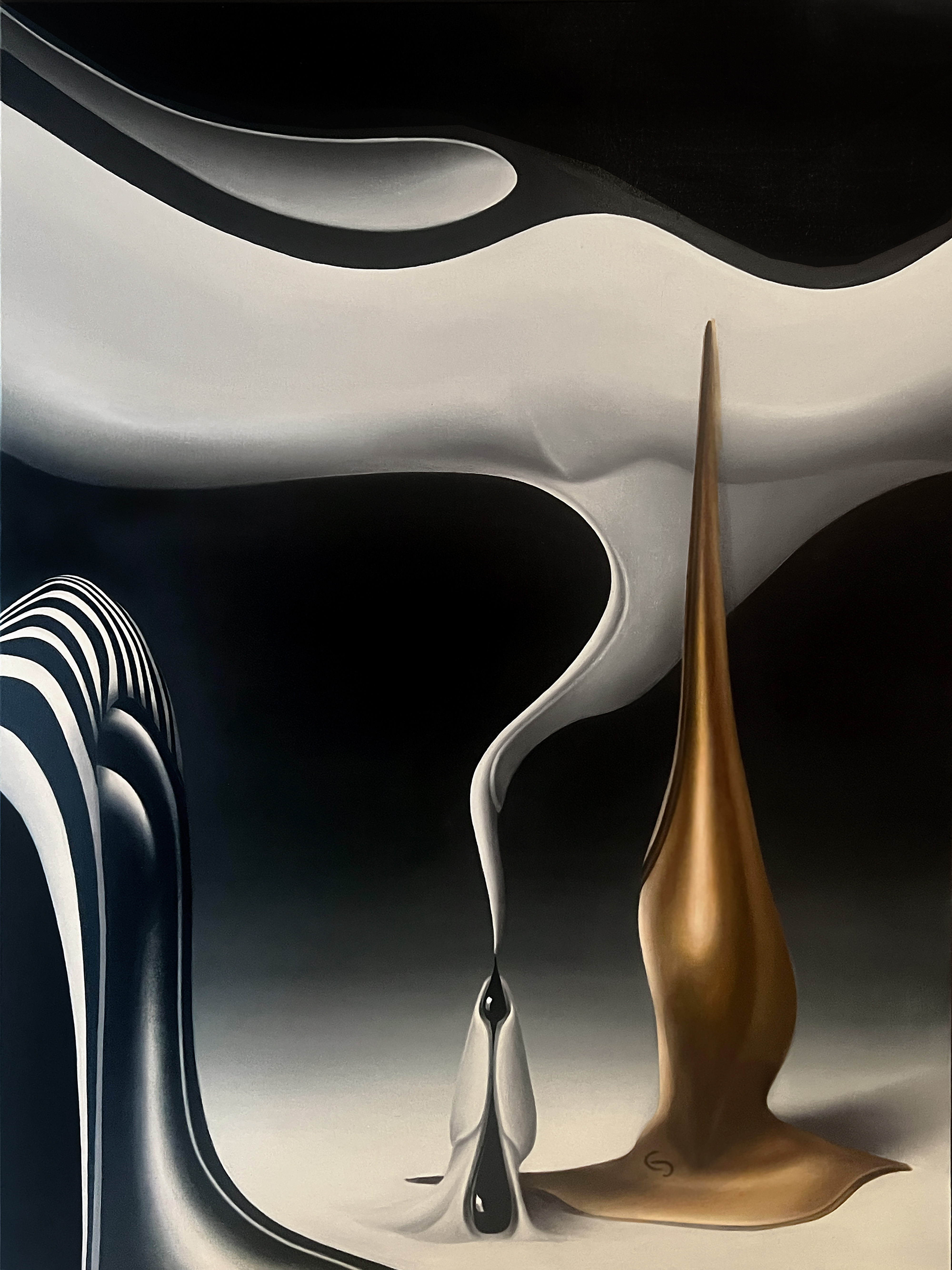
DIMENSIONALISM MANIFESTO
About This Statement This document articulates the foundational principles of Dimensionalism, an artistic philosophy developed by Shilowska Pretto through a body of transmissions retrieved over a period of deep perceptual reorientation. Dimensionalism does not emerge from critique or rebellion. It is not a style, trend, or manifesto in the conventional sense. It is the record of a shift: an ontological, cognitive, and aesthetic divergence that requires its own architecture, guided by a radical premise: True vision does not begin with seeing. It begins with deprogramming. Rather than announcing itself through spectacle or opposition, Dimensionalism establishes a new frequency of attention. Its aim is to disrupt the perceptual mechanisms trained to recognize the world in only one way. At its core, Dimensionalism moves beyond compulsory meaning. It does not ask the viewer to solve the image. It does not require interpretation as proof of contact. It creates a space in which experience can stabilize without immediate resolution. Meaning may appear, but it is no longer in control. I. Origins Dimensionalism did not begin as a theory. It emerged from the lived experience of perceptual fracture: an inner rupture that made familiar forms unintelligible and required the construction of a new visual language. This language did not arise from imagination or narrative. It appeared in the form of visual transmissions: nonlinear, insistent signals that bypassed thought and asked to be sealed into form. These transmissions became what are now called quantum imprints. Their purpose was never to illustrate or explain. Their function is to interfere with the structure of recognition itself. What emerged through this process became more than a sequence of images. It formed a terrain where perception is reshaped at its root. II. Beyond Compulsory Meaning Dimensionalism does not operate within the conventional relationship between perception and meaning. It does not suspend meaning temporarily in order to later restore it. It proposes a more fundamental shift: meaning is no longer required as the condition for experience. Human perception is trained to resolve, classify, and stabilize reality through immediate interpretation. This compulsion toward meaning is not neutral. It defines identity, behavior, social roles, and the perceived limits of possibility. Dimensionalism interrupts this mechanism. It establishes perceptual fields in which interpretation is not enforced, categorization is not necessary, and resolution is not required. This is not ambiguity for its own sake. It is the stabilization of awareness within the unresolved. In this state, perception precedes interpretation. Presence precedes identity. Experience is not governed by conclusion. Dimensionalism does not guide the viewer toward answers. It removes the necessity of answering. III. Dimensional Cognition In Dimensionalism, form is no longer tasked with explanation or appeal. It becomes a frequency that alters how perception arranges itself. Each quantum imprint is a constructed field: a cognitive disruptor designed to shift internal rhythm, dissolve habitual meaning, and open the space for a different form of intelligence to surface. The viewer is treated as an organ of perception: active, intelligent, and responsive. Dimensionalism assumes that complexity can be felt without needing to be solved. There is no final resolution, no imposed theme, no single statement. Meaning is allowed, but never demanded. What remains is the act of entry. IV. Perceptual Latency Dimensionalism functions by delaying the automatic closure of perception. In most contexts, perception follows a rapid sequence: stimulus → classification → meaning → emotional response Dimensionalism interrupts this sequence. It introduces latency between perception and interpretation, allowing awareness to remain active without immediate resolution. This delay is not passive. It requires attention, presence, and cognitive participation. The viewer is no longer a consumer of meaning, but an active participant in perception. V. Perception as Architecture Experience does not arrive on its own. Perception builds the framework through which it becomes real. What we believe to be reality is shaped by learned filters, trained priorities, and coded attention. When those filters are interrupted, the structure of life begins to shift: neurologically, emotionally, and existentially. Dimensionalism functions as a tool of perceptual reconfiguration. It interrupts inherited formatting and proposes the construction of new perceptual pathways not limited by language, representation, identity, or preassigned meaning. To see differently is not merely to interpret the world in a new way. It is to inhabit an entirely different range of choices, emotions, and possibilities. VI. The Image as Carrier In Dimensionalism, the image no longer serves representation. Its purpose is not to mirror reality or perform meaning. It becomes a carrier of latent frequency activated through direct perceptual resonance. Each piece is a deliberately composed environment of disruption. These visual fields are engineered to produce subtle collapses in cognitive patterning, allowing a less conditioned form of perception to surface. Interpretation fades in importance. What remains essential is presence. VII. Refusal of Representation The visible world is not the site of Dimensionalist inquiry. These transmissions do not depend on bodies, symbols, autobiography, or narrative content. They operate outside recognition. This refusal emerges from necessity, both technical and philosophical. As long as form clings to the already visible, it forfeits its generative power. The work begins in the instability of form, in the interval where perception has not yet surrendered to classification. VIII. Precision Without Submission Dimensionalism does not reject structure. It maintains high levels of precision, coherence, and aesthetic discipline. However, this structure is not derived from inherited systems: artistic, social, cultural, or conceptual. It is constructed independently. This creates a condition in which the work appears ordered, the presence appears controlled, and the system appears stable yet it does not obey familiar frameworks. This tension produces a perceptual interruption: coherence without compliance. The viewer encounters something that holds authority but cannot be fully categorized within existing models. This is not rebellion. It is the removal of structural dependency. IX. Integration of Science and Symbol While grounded in aesthetics, Dimensionalism is aligned with contemporary inquiries in neuroscience, symbolic cognition, perceptual studies, and quantum coherence theory. The work is not decorative. It is structured according to its own internal logic, anchored in signal, symmetry, vibration, ambiguity, restraint, and precision. Its transmissions are visually unfamiliar because they are designed to reach unfamiliar perceptual circuits. X. Departure from Identity and Irony Dimensionalism is not configured through gender, biography, sociopolitical positioning, or ironic distance. It acknowledges the relevance of these frameworks but does not rely on them for authority. It proceeds through a different logic: signal coherence rather than critique. Its sincerity is not naïve. It is structural. XI. Construction of New Fields Dimensionalism proposes that perception is programmable, and therefore reprogrammable. By engaging with unfamiliar signals, the viewer participates in the construction of new internal environments. These shifts do not remain within the frame. They extend to cognition, memory, emotion, identity, and choice. The implications exceed aesthetics. They touch the infrastructure of time, space, and self. XII. Aesthetic Sincerity and Signal Fidelity In an era saturated with self-reference, spectacle, and conceptual irony, Dimensionalism moves through form with a different intention. Sincerity becomes a technical tool, shaping perception without theatricality or citation. Each visual field builds authority from within, without leaning on quotation, nostalgia, or external validation. The axis has already shifted. XIII. Closing Statement Dimensionalism operates outside stylistic boundaries. It generates a visual, cognitive, and philosophical configuration through which new modes of perception and new dimensions of life can emerge. It does not create meaning as its final purpose. It creates the conditions where meaning is no longer necessary. Meaning is allowed. It is simply no longer in control. Shilowska Pretto Founder of Dimensionalism Artist, Theorist, Frequency Architect San José, Costa Rica, 2026 Archived by the Archive for Trans-Contextual Inquiry ATI Institute, Seoul/Berlin