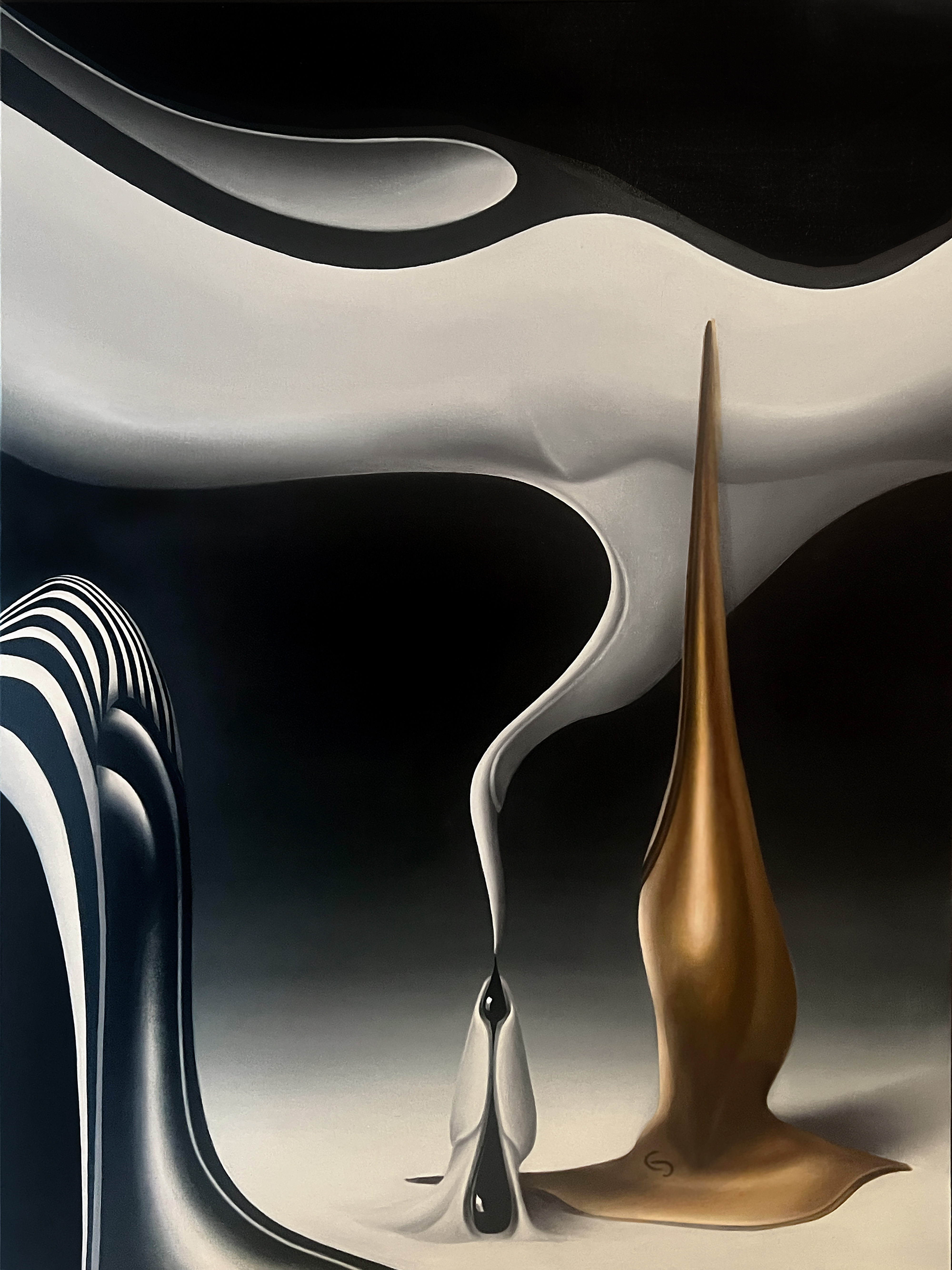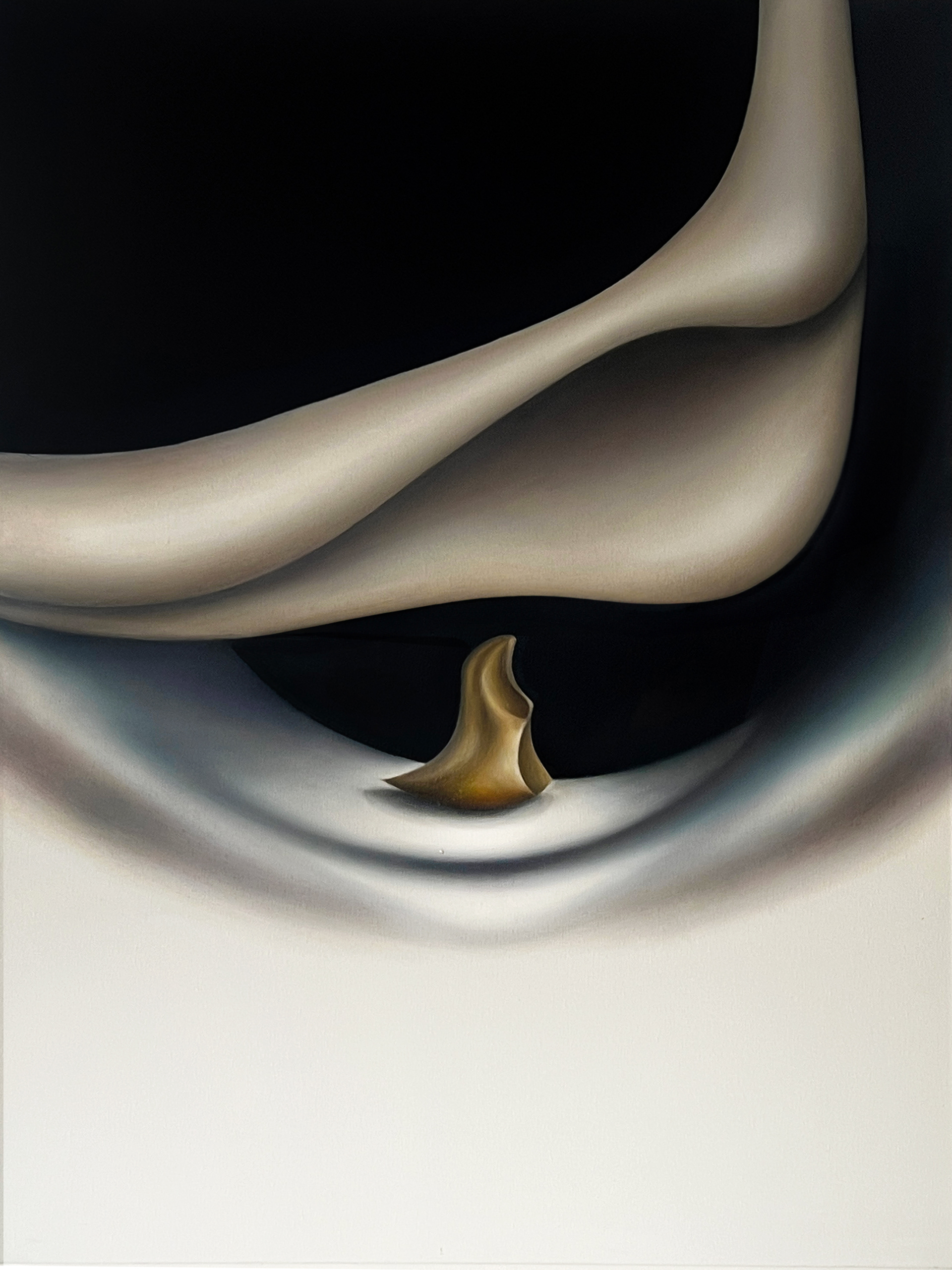
Oil on Canvas 97 X 130 CM 2026 Collection: Timeless Majesty No TM-V-04 Among the paintings comprising Timeless Majesty, Elarisse demonstrates how perceptual engagement can be intensified through reduction rather than accumulation. The composition is notably restrained, yet prolonged observation reveals a level of visual activity that exceeds its apparent simplicity. The dominant white structure establishes neither a fixed object nor a recognizable figure. Instead, it behaves as a continuously adapting spatial event. As the observer’s attention moves across its surface, subtle changes in curvature, tension and implied weight repeatedly reorganize the perceptual field without producing a final, stable interpretation. Equally significant is the relationship between the suspended form and the small golden structure positioned beneath it. Although physically separated, the two elements are experienced as functionally connected. The surrounding negative space does not simply divide them; it actively participates in maintaining their perceptual relationship. Here, absence functions as an organizing component rather than empty background. Unlike visual compositions that depend upon immediate recognition, Elarisse appears to reduce the speed of perceptual resolution itself. The observer remains engaged because each moment of apparent understanding subtly alters the conditions for the next. Looking becomes less an act of identification than one of continuous recalibration. From a neuroaesthetic perspective, this sustained modulation of attention may prove especially significant. Rather than encouraging rapid categorization, the work appears to prolong exploratory visual processing, allowing perceptual organization to remain unusually flexible over time. Whether such effects can be measured experimentally remains an open empirical question, but the observable phenomenology remains remarkably consistent across extended viewing. Within Timeless Majesty, Elarisse illustrates that visual restraint need not diminish experiential depth. On the contrary, the painting suggests that carefully structured simplicity may increase the duration and sensitivity of perceptual engagement, allowing the observer to encounter vision itself as an active, evolving process rather than a completed act of recognition. Dr. Thea Anastos Neuroaesthetic Research Unit Archive for Trans-Contextual Inquiry (ATI, Seoul/Berlin)