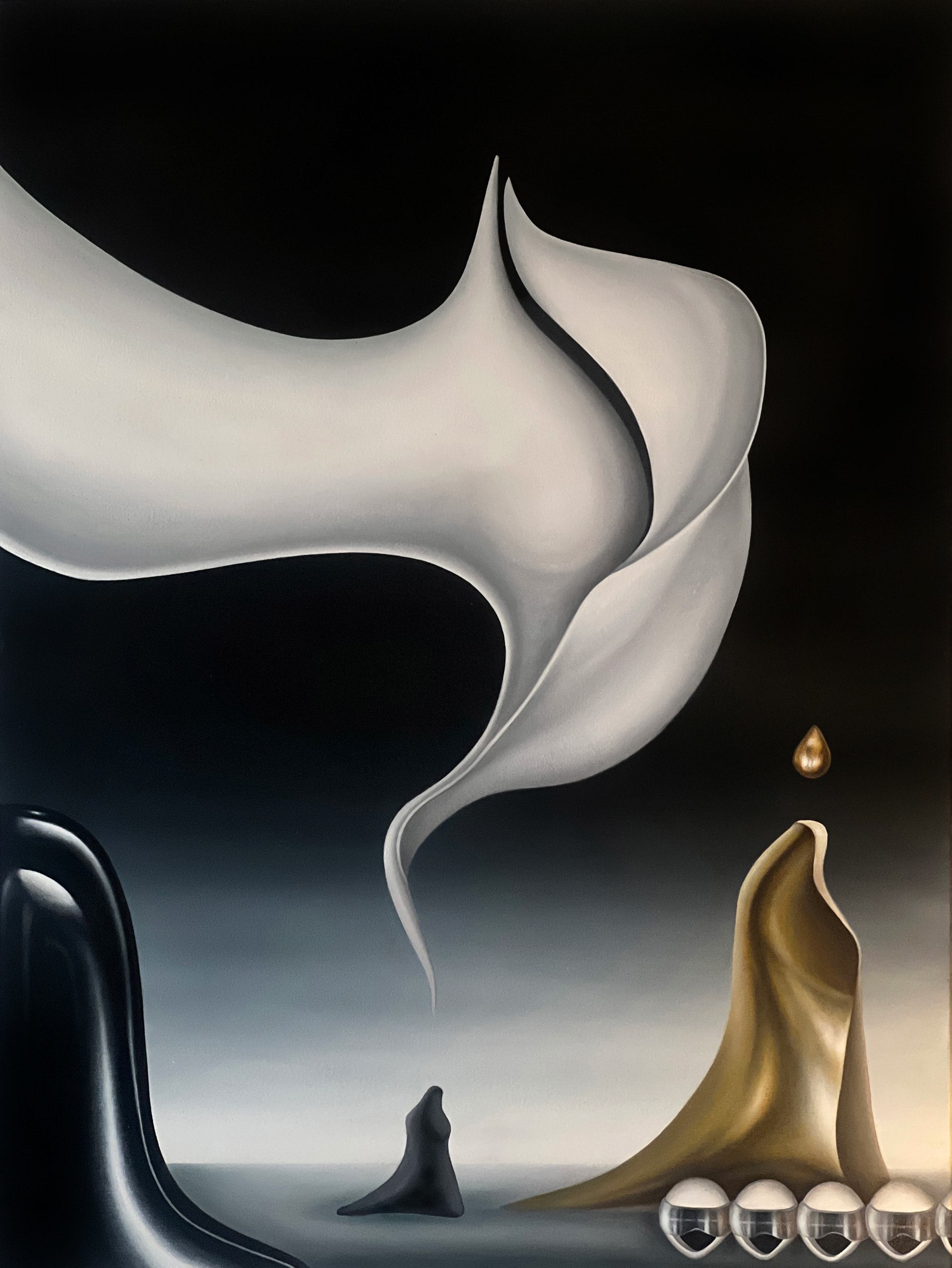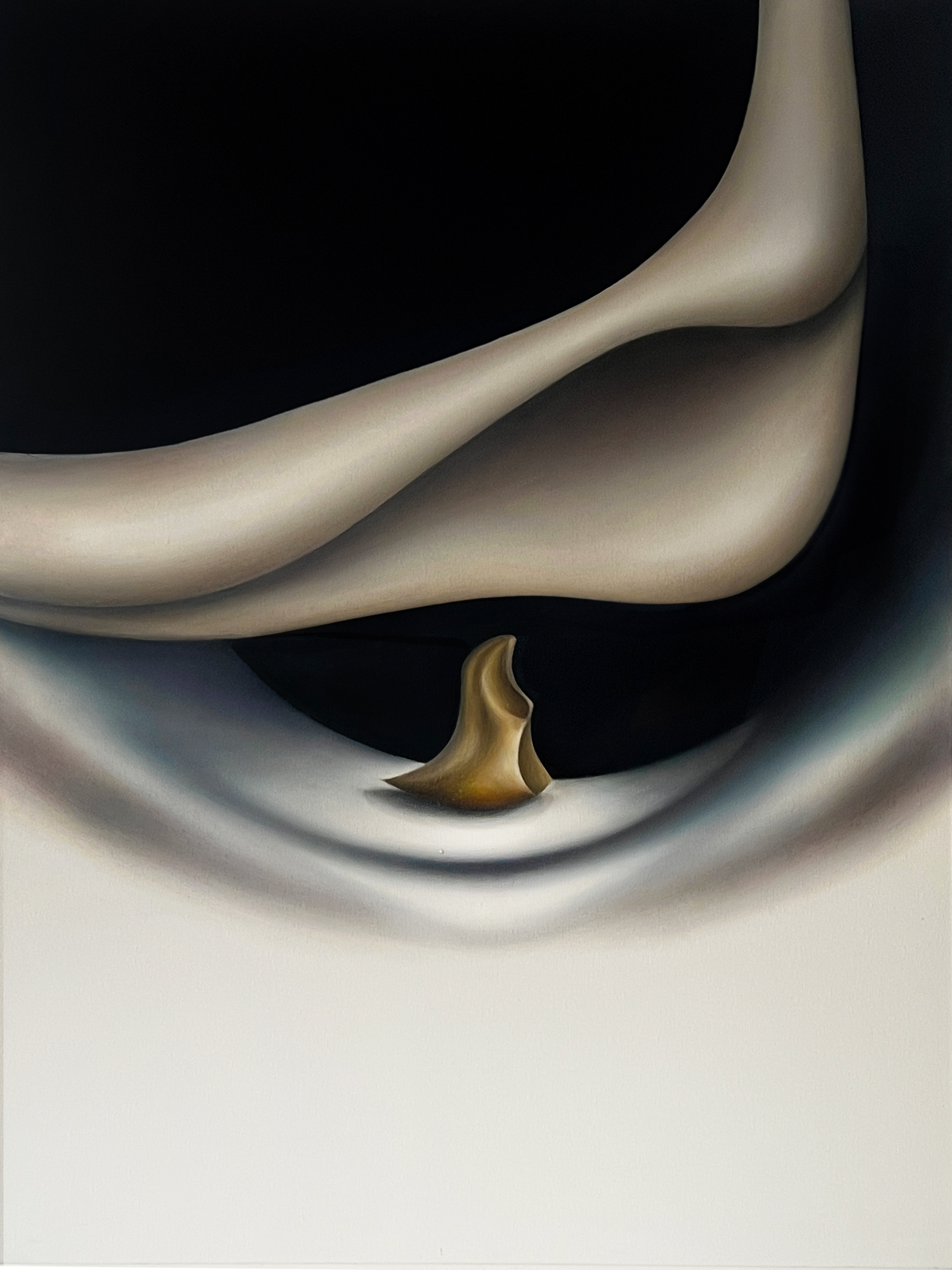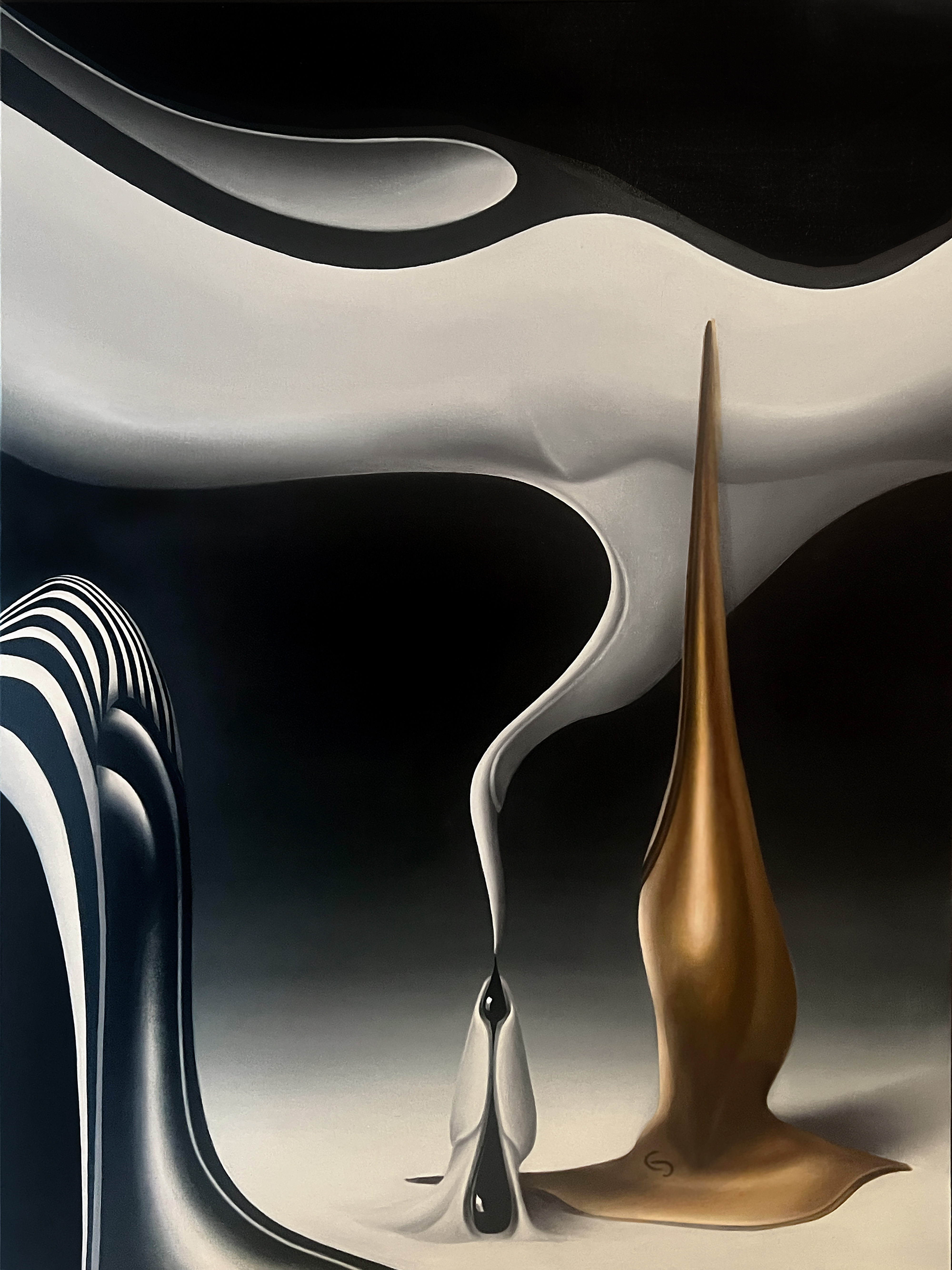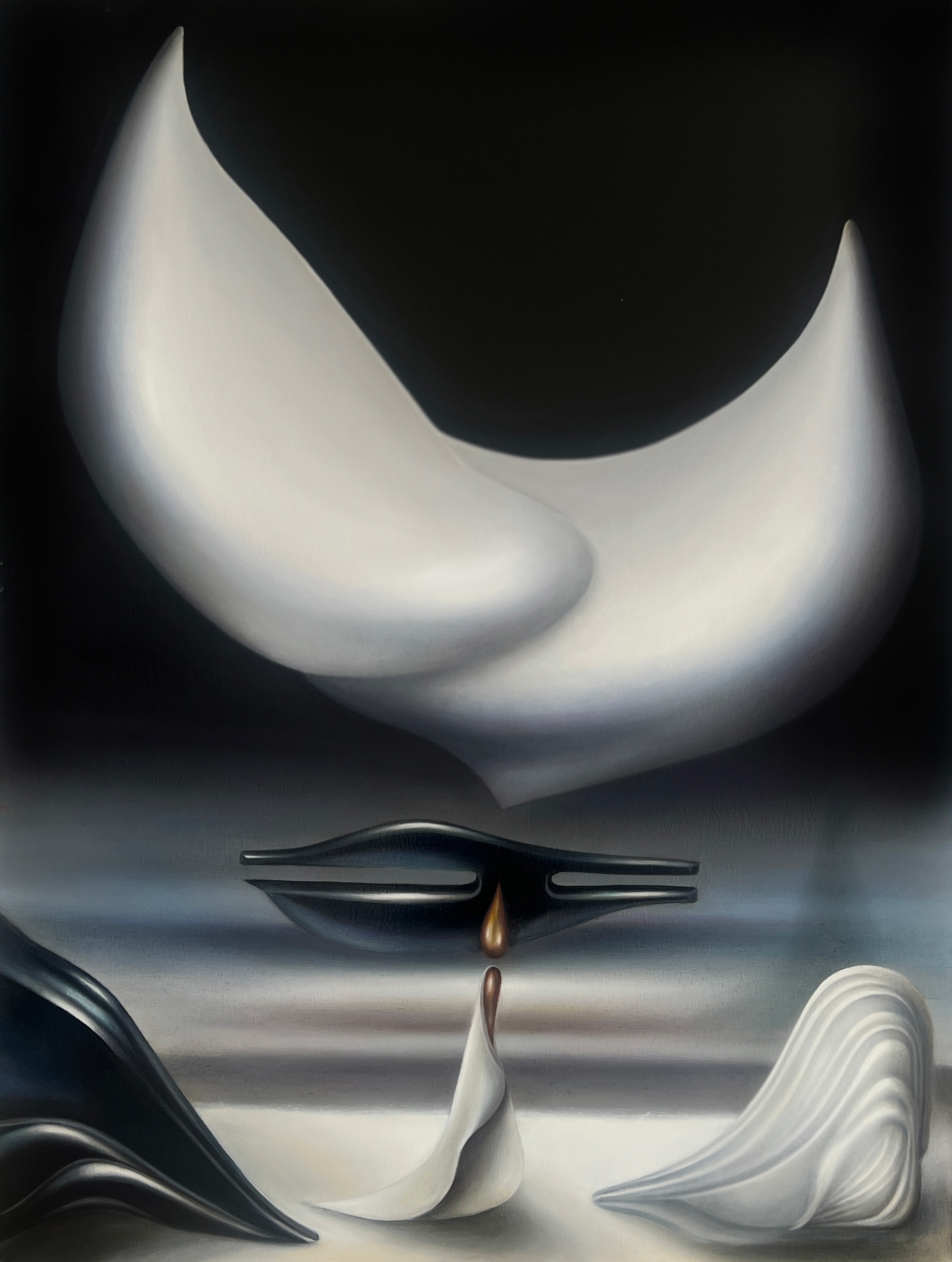
Oil on Canvas 97 X 130 CM Collection: TIMELESS MAJESTY No. TM-V.O3 Among the works comprising Timeless Majesty, Vorleanth presents an unusually clear example of perceptual instability generated through formal restraint rather than visual complexity. The composition offers relatively few elements, yet the observer rarely settles into a single, stable reading of the image. Instead, perception appears to move through successive states of organization. Forms that initially seem self-evident gradually lose their certainty as neighbouring relationships become more perceptually dominant. Rather than replacing one interpretation with another, the painting allows multiple organizations of the visual field to coexist without fully resolving. This phenomenon deserves attention because it departs from the mechanisms commonly associated with perceptual ambiguity. Many ambiguous images rely upon competing representations that alternate between two recognizable interpretations. Vorleanth functions differently. Its uncertainty does not arise from hidden figures or visual puzzles, but from the continuous reorganization of spatial relationships, volume, gravity and visual expectation. Particularly significant is the relationship between the suspended white form and the restrained arrangement occupying the lower register. Neither element functions independently. Small shifts in attention alter the perceived stability of the entire composition, suggesting that meaning emerges not from isolated objects but from the dynamic relationships established between them. From a neuroaesthetic perspective, this prolonged absence of perceptual closure may be more consequential than immediate recognition. Rather than rewarding rapid classification, the work appears to sustain an active state of visual negotiation. Such prolonged engagement may recruit cognitive processes associated with predictive updating, spatial integration and flexible perceptual organization, although further empirical investigation would be required before stronger conclusions could be drawn. Whether these effects prove measurable remains an open question. What can be observed with greater confidence is that Vorleanth consistently resists premature perceptual stabilization. The painting does not simply present an image for interpretation; it maintains conditions under which perception continues to reorganize itself . Within the broader development of Timeless Majesty, Vorleanth demonstrates that increasing formal economy need not reduce perceptual richness. On the contrary, the work suggests that carefully structured visual restraint may create conditions in which perception remains active long after recognition would ordinarily conclude. Dr. Thea Anastos Neuroaesthetic Research Unit Archive for Trans-Contextual Inquiry (ATI, Seoul/Berlin)